
Blockchain Smart Contract Development Timelines: From Requirements to Mainnet Deployment
September 8, 2026
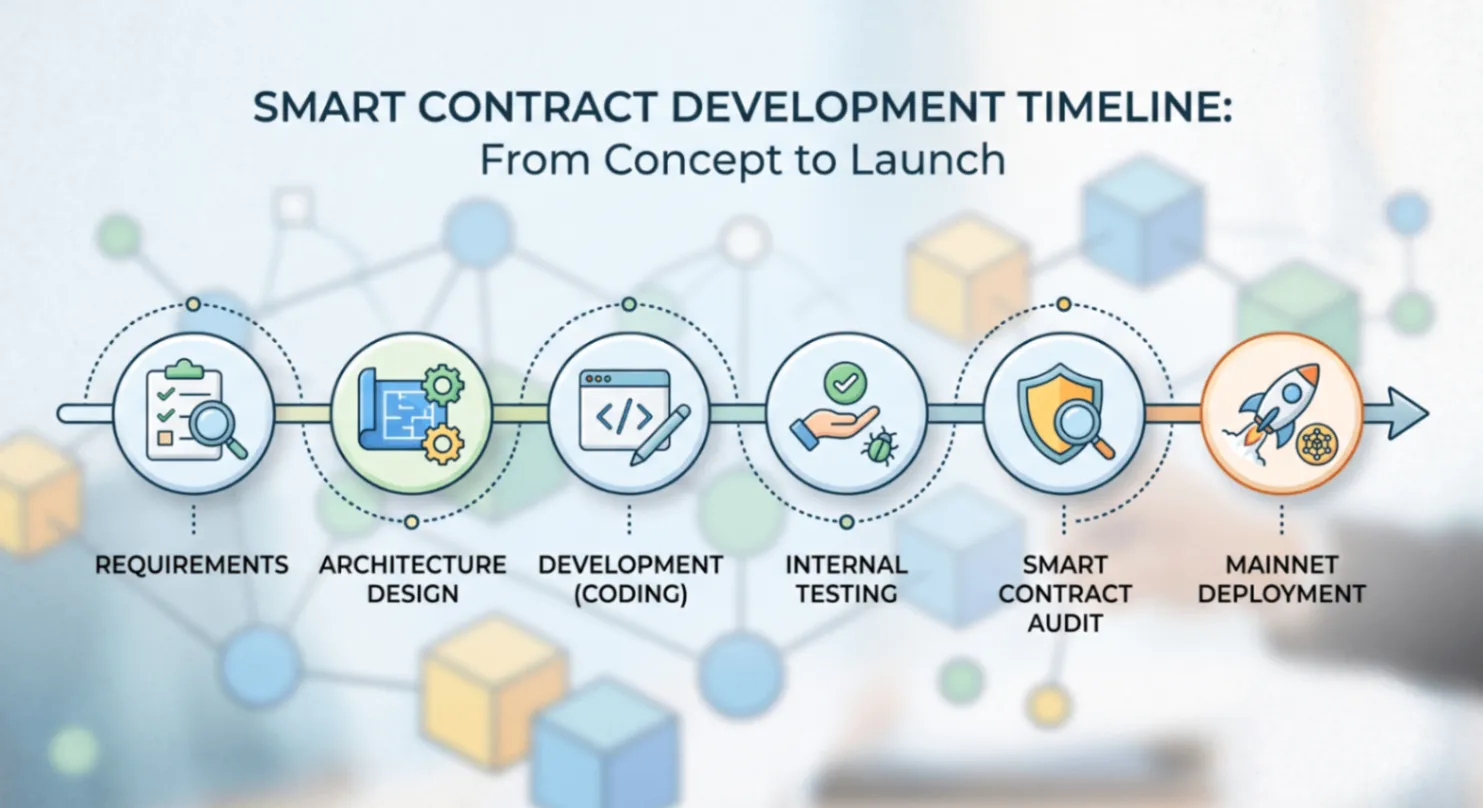
Founders planning a blockchain smart contract development project almost always underestimate the timeline, not because any single stage takes unreasonably long, but because they're only picturing the coding part. A realistic timeline has to account for everything that happens before a line of Solidity gets written and everything that happens after it's technically "done," the full sequence we lay out in our stage-by-stage breakdown of smart contract development services.
Requirements and Specification
This stage is where the contract's actual behavior gets pinned down: what state it holds, what functions it exposes, who can call what, and under what conditions. It's tempting to rush this to get to "real work," but time spent here is the cheapest time in the whole project. A requirement that changes during development costs far more to accommodate than one that gets caught and settled before coding starts.
Architecture Design
Once requirements are settled, architecture design decides how the contract will actually be structured: chain and virtual machine choice, a decision we compare in EVM vs non-EVM architecture trade-offs, whether the contract needs to be upgradeable and if so which upgrade pattern it will use, access-control design, and how it will interact with any external contracts or oracles it depends on. This stage is where a lot of a contract's long-term security posture gets determined, since retrofitting access control or upgrade mechanisms after development is underway is far more disruptive than designing them in from the start.
Development
With architecture settled, actual coding tends to be the most predictable stage of the timeline, since effort scales fairly directly with the number of functions, integration points, and edge cases the specification calls for. This is also where development practices matter: clear code structure and documentation here make every later stage, testing, audit, maintenance, faster and cheaper, which in turn affects what a smart contract development company actually charges for the whole engagement.
Internal Testing
Before anything goes to an external auditor, internal testing should cover unit tests for individual functions, integration tests for how functions interact, and scenario testing against edge cases the specification identified. Skipping or rushing internal testing doesn't actually save time, it just shifts the cost of finding those bugs to the audit stage, where fixing something requires a re-audit cycle, which is slower and more expensive than catching it internally first.
External Audit
A third-party audit is the stage most likely to have unpredictable duration, because auditors doing their job properly will flag issues that need fixing and re-checking, the kind of issues we walk through in common smart contract vulnerabilities and how audits catch them. This is exactly why an audit needs to be built into the timeline as its own scoped phase from the start, with realistic time budgeted for at least one round of fixes and re-review.
Testnet Staging
Testnet deployment is where the contract runs in a live-like environment without real capital at risk. This stage should simulate realistic usage patterns, not just a single happy-path walkthrough, and it's where gas-cost surprises, integration issues with front-end or off-chain systems, and any remaining edge-case bugs tend to surface. Compressing this stage to hit a launch date is one of the more common ways teams end up debugging in production instead.
Mainnet Deployment and Handover
The deployment itself is usually quick, the real work at this stage is the handover: documenting deployment keys and admin roles, confirming who holds upgrade authority if the contract is upgradeable, and making sure ownership and IP terms, ideally already agreed in writing before the project started, are reflected in what's actually delivered. A clean handover here sets up everything that comes after, including any ongoing maintenance and upgrades the contract will need over its lifetime.
Building a Realistic Timeline
Adding these stages together, requirements, architecture, development, internal testing, external audit with a fix cycle, testnet staging, and handover, gives a far more realistic picture than a timeline that only accounts for "writing the contract." Projects that budget honestly for every one of these stages tend to hit their launch dates; projects that treat everything except development as a rounding error tend to slip, often right at the audit or testnet stage where the real risk was always concentrated. You can see the full list of stages we run on every engagement on our services page.