
Blockchain Smart Contract Development: EVM vs Non-EVM Architecture Trade-offs
August 6, 2026
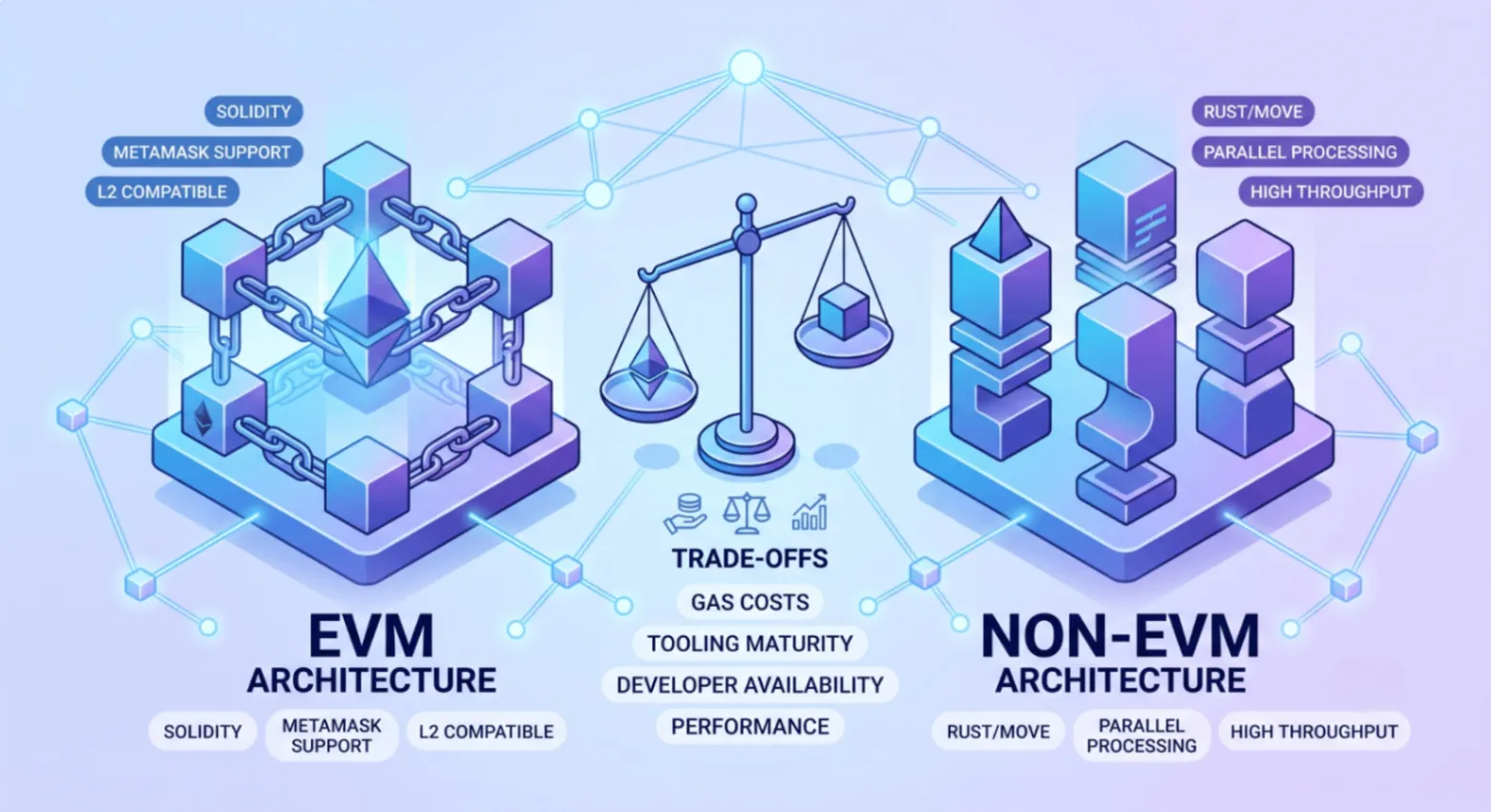
One of the earliest and most consequential decisions in any blockchain smart contract development project is which execution environment to build for. Most founders default to EVM-compatible chains without seriously weighing the alternatives, and in most cases that default is actually the right call — but it should be a deliberate decision, not an assumption. This post walks through the real trade-offs between EVM and non-EVM architectures across the dimensions that actually affect a project: gas costs, tooling maturity, developer availability, and performance characteristics.
What “EVM-Compatible” Actually Means
The Ethereum Virtual Machine is the runtime that executes smart contract bytecode on Ethereum and a large family of chains built to be compatible with it — Polygon, Arbitrum, Optimism, Base, BNB Chain, Avalanche’s C-Chain, and dozens of others. “EVM-compatible” means these chains can run Solidity contracts largely unmodified, using the same tooling, the same mental model for gas, and the same developer libraries. This compatibility is the single biggest reason EVM chains dominate production dApp deployments today: a contract written and tested for one EVM chain typically requires only minor adjustments to deploy on another.
Non-EVM chains — Solana, chains built on the Cosmos SDK, Aptos and Sui using the Move language, and others — use fundamentally different execution models, programming languages, and account structures. This isn’t a minor implementation detail; it changes how contracts are architected from the ground up.
Gas Costs and Performance
This is usually the first thing founders ask about, and the honest answer is: it depends heavily on which specific chains you’re comparing, not just “EVM vs. non-EVM” as a category.
Ethereum mainnet itself can have gas costs that make certain contract patterns — frequent small transactions, on-chain order books, high-frequency state updates — economically impractical. This is precisely why EVM-compatible Layer 2s exist: Arbitrum, Optimism, and Base inherit EVM compatibility while dramatically reducing transaction costs by batching and settling to Ethereum periodically rather than executing every transaction on the base layer.
Solana, by contrast, was designed from the ground up for high throughput and low per-transaction cost, using a different consensus mechanism (Proof of History combined with Proof of Stake) and a parallelized execution model that allows non-conflicting transactions to process simultaneously rather than sequentially. For applications that require very high transaction volume at very low cost per transaction — certain DEX order-book models, gaming applications, high-frequency trading infrastructure — this architecture can offer a genuine performance advantage over even EVM L2s.
The trade-off is that this performance comes from a fundamentally different programming model (Rust-based, using Solana’s account model rather than Ethereum’s storage model), which brings its own complexity and a smaller pool of experienced developers.
Tooling Maturity
This is where the gap between EVM and most non-EVM ecosystems is still the widest, and it’s a practical consideration that matters as much as raw technical capability. The EVM ecosystem has had roughly a decade to mature: Hardhat and Foundry are both battle-tested development frameworks with extensive documentation, Slither and other static analysis tools are purpose-built for Solidity vulnerability patterns, and the audit industry itself is overwhelmingly oriented around EVM contracts — meaning it’s easier to find experienced auditors, faster to get audit slots booked, and cheaper on average, simply due to supply and demand.
Non-EVM ecosystems are catching up quickly but unevenly. Solana’s tooling (Anchor as a framework, for instance) has matured substantially, and Move-based chains like Aptos and Sui have introduced language-level safety features specifically designed to prevent certain classes of bugs that have historically plagued Solidity contracts, like resource duplication. But the breadth of third-party tooling, the size of the auditor pool with deep chain-specific experience, and the volume of publicly documented incident post-mortems to learn from all remain smaller than the EVM ecosystem’s.
Developer Availability and Long-Term Maintenance
This is a business consideration as much as a technical one. Solidity remains, by a wide margin, the most widely known smart contract language, which means a larger available talent pool for both initial development and long-term maintenance after your original development team moves on to other projects. If your project’s long-term plan involves hiring an in-house engineering team eventually, or if you need to be able to quickly bring on additional contract developers during a crunch period, this availability gap is worth weighing seriously — a non-EVM chain with excellent technical properties but a thin local talent pool can leave you dependent on a small number of specialized vendors.
When Non-EVM Genuinely Makes Sense
None of this means EVM is always the right answer. Non-EVM chains are worth serious consideration when:
- Your application’s core value proposition depends on transaction throughput or cost that EVM chains — even L2s — can’t practically match
- You’re building specifically within an ecosystem (a Cosmos-based appchain, for instance) where interoperability with that specific chain family is the product itself, not a technical afterthought
- Your team already has deep expertise in the relevant language and execution model, reducing the talent-availability concern significantly
A Side-by-Side Comparison
| Dimension | EVM-Compatible Chains | Non-EVM Chains (Solana, Move-based, Cosmos SDK) |
|---|---|---|
| Language | Solidity (dominant), Vyper (niche) | Rust (Solana/Anchor), Move (Aptos/Sui), Go/CosmWasm (Cosmos) |
| Tooling maturity | High — Hardhat, Foundry, Slither, mature audit market | Improving quickly, but smaller third-party ecosystem |
| Developer availability | Largest available talent pool | Smaller, more specialized, often costlier to hire |
| Base-layer gas cost | Can be high on L1; low on L2s (Arbitrum, Base, Optimism) | Generally low by design, especially Solana |
| Throughput | Constrained on L1; L2s close much of the gap | Often higher out of the box due to parallelized execution |
| Interoperability | Broadest cross-chain bridge and infrastructure support | Growing, but more fragmented across ecosystems |
| Audit market depth | Largest, most competitive | Smaller pool, longer lead times for specialized auditors |
This table isn’t meant to declare a universal winner — it’s meant to make explicit what founders are actually trading off when they pick a chain family, so the decision can be made against real project requirements rather than default assumptions about “what everyone else uses.”
Migration Costs Are Rarely Trivial
It’s also worth being clear-eyed about what happens if a chain choice turns out to be wrong after development has already started. Migrating a contract system from an EVM chain to a non-EVM one — or vice versa — is not a matter of redeploying the same logic elsewhere. It typically means a substantial rewrite: different language, different account and storage models, different testing frameworks, and in many cases, a fresh audit cycle since prior audit findings don’t transfer across languages. For a mid-complexity contract set, this can realistically add 60–80% of the original development timeline back onto the project. This is the strongest practical argument for treating the EVM-vs-non-EVM decision as a first-order architecture question resolved during the specification stage, rather than something revisited mid-build.
A Framework for Making the Decision
Rather than treating this as an ideological choice, we recommend founders work through three questions in order: What does the application actually need in terms of throughput and cost, measured against realistic usage projections rather than best-case scenarios? What’s the realistic total cost of ownership over 12–24 months, factoring in audit costs, developer availability, and tooling maturity, not just initial development? And does the target user base already live predominantly on one ecosystem, such that chain choice affects distribution as much as engineering?
For the majority of production dApps — marketplaces, DeFi protocols, DAOs, NFT platforms — EVM-compatible chains, particularly Layer 2s, offer the best combination of cost, tooling maturity, and talent availability today. But for applications where raw throughput is the product, or where a specific non-EVM ecosystem is the natural home for the user base you’re targeting, the trade-off can absolutely tip the other way. The point isn’t to default to either option — it’s to make the call deliberately, with the actual trade-offs on the table, before architecture decisions are locked in and expensive to reverse.
Where This Fits Into the Broader Build
Chain selection doesn’t happen in isolation — it’s one input among several during the architecture phase of a project, alongside decisions about upgradeability, access control patterns, and how the contract layer will interface with off-chain infrastructure like indexers and front-end services. Founders evaluating vendors should expect any competent blockchain smart contract development partner to walk through this trade-off explicitly during early scoping calls, backed by references to public chain documentation and cost data rather than general assertions about which ecosystem is “better.” A team that can articulate the trade-offs relevant to your specific application, rather than pushing a one-size-fits-all default, is a reasonable proxy for how carefully they’ll approach the rest of the architecture as well.