
Smart Contract Development Services Explained: From Audit to Mainnet Deployment
August 6, 2026
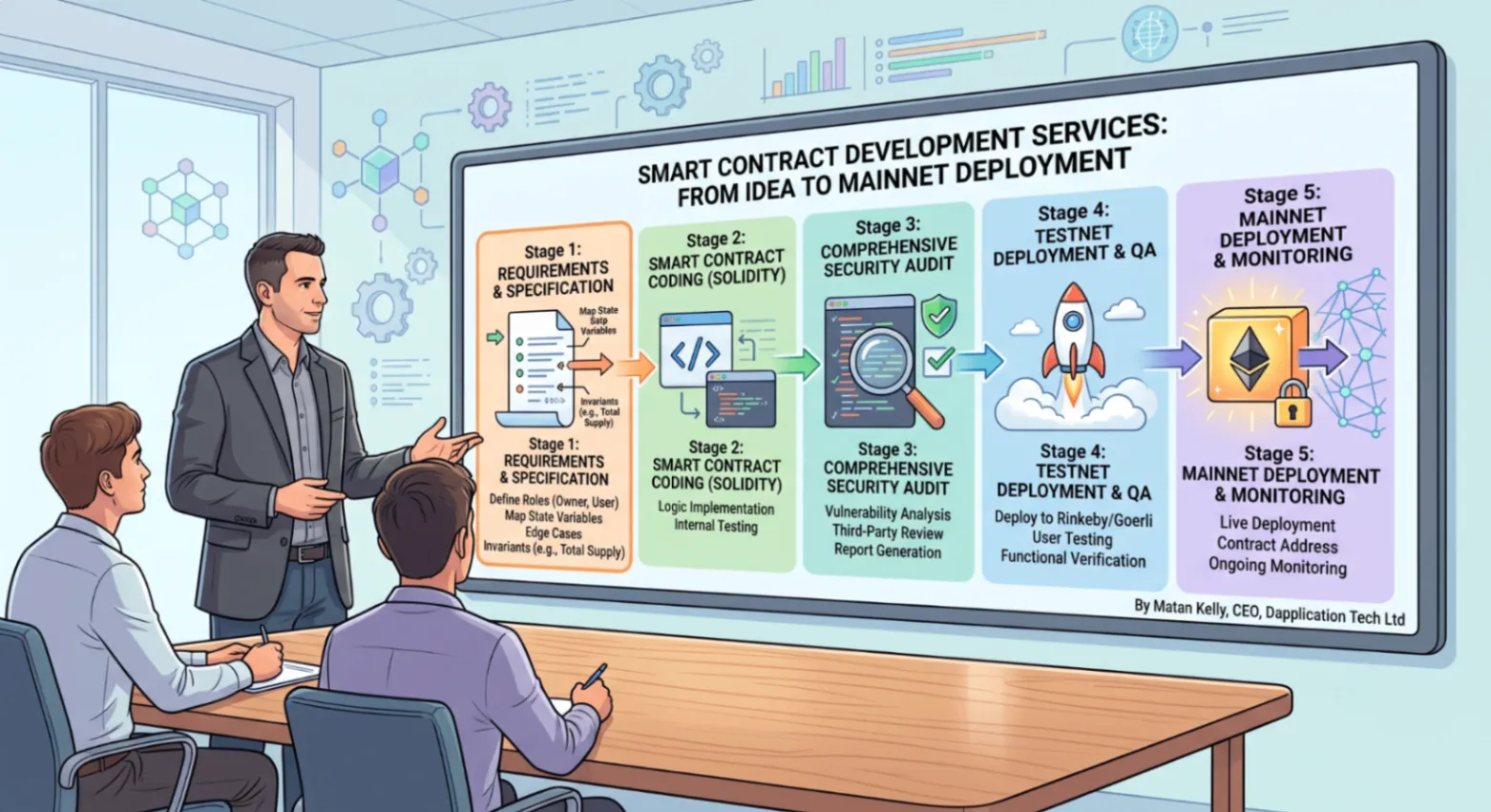
Founders often come to us with a rough idea of what they need — “we need smart contracts built” — without a clear picture of what that actually involves from first requirements call to a live mainnet address. Smart contract development services, done properly, are not a single deliverable but a sequence of distinct stages, each with its own outputs, risks, and checkpoints. Understanding that sequence helps you scope a project accurately, budget for the right things, and know what “done” should actually look like.
Here’s how a full engagement typically breaks down, stage by stage, following the structure we use on our own delivery work.
Stage 1: Requirements and Specification
Before any code is written, the goal of this stage is to translate a product idea into a precise technical specification: what state the contract manages, what functions it exposes, what roles exist (owner, admin, user), and what invariants must always hold true (for example, “total supply can never exceed X” or “only the multisig can trigger an upgrade”). This stage also surfaces edge cases early — what happens if a transaction is sent with zero value, what happens during a network reorg, how the contract behaves under gas price spikes.
Skipping or rushing this stage is the single most common cause of scope creep later. A specification document, even a lightweight one, gives both sides a shared reference point and makes it far easier to catch design flaws on paper rather than after deployment.
Stage 2: Architecture Design
With requirements locked, the next step is architectural design: deciding on the contract structure (monolithic vs. modular), whether to use upgradeable proxy patterns or immutable contracts, how access control is handled, and which standards to build against (ERC-20, ERC-721, ERC-4626, or a custom implementation). This is also where chain selection gets finalized if it wasn’t already fixed — EVM-compatible chains remain the default for most production dApps given tooling maturity, but the decision should be explicit rather than assumed.
Architecture decisions made here are expensive to reverse later, so this stage typically involves more back-and-forth with the client than any other.
Stage 3: Development
This is where the bulk of engineering hours go. In our process, contracts are built using Hardhat or Foundry as the core development framework, with unit tests written alongside — not after — each function. Foundry in particular has become the standard for teams that want fast, Solidity-native fuzz testing baked directly into the development loop, and we default to it for anything handling meaningful value.
Development is done in small, reviewable increments rather than one large push. Each function or module goes through peer review before merging, and static analysis tools like Slither run automatically against every commit to catch common vulnerability patterns — reentrancy, unchecked external calls, integer issues — before a human reviewer even looks at it.
Stage 4: Internal Testing
Before anything leaves the development environment, contracts go through several layers of testing:
- Unit tests covering every public and external function, including expected failure cases
- Fuzz testing using Foundry’s built-in fuzzing to throw randomized inputs at functions and surface edge cases a human wouldn’t think to test manually
- Integration tests simulating how the contract behaves alongside any external dependencies — price oracles, other protocol contracts, token standards it interacts with
Coverage reports are generated at this stage, and any function below a defined coverage threshold gets flagged before moving forward.
Stage 5: External Audit
Internal testing catches a meaningful share of issues, but it’s not a substitute for an independent, external audit — and any smart contract development company that positions internal QA as a replacement for third-party review should be treated with caution. External auditors bring fresh eyes, specialized tooling, and no incentive to rush toward a launch date. For contracts handling significant value, we recommend budgeting for this as a standard project phase, not an optional add-on, and building the audit firm’s turnaround time directly into the launch timeline.
Stage 6: Testnet Staging
Once audit findings are resolved, the contract is deployed to a public testnet — Sepolia is the current standard for Ethereum-based projects — where it’s exercised under conditions closer to production: real wallet interactions, front-end integration testing, and monitoring for any behavior that differs from what internal tests predicted. This stage typically runs for at least a week for anything non-trivial, giving time for the client’s own team to interact with the live testnet deployment and confirm it matches expectations.
Stage 7: Mainnet Deployment and Handover
Deployment to mainnet is treated as its own discrete event, not an afterthought tacked onto the end of testnet staging. This includes a final gas-cost review, a deployment runbook with rollback steps if something goes wrong mid-deployment, and — critically — a full handover of admin keys, multisig roles, and contract ownership to the client, along with documentation covering every function and access-control role in the deployed contract.
How Pricing Typically Maps to These Stages
One of the most common points of confusion for founders is why two vendor quotes for what sounds like “the same contract” can differ by a factor of two or three. Almost always, the gap comes down to which of the seven stages above are actually included in the number. A quote that only covers Stages 1–3 (requirements through development) will look far cheaper than one covering the full pipeline through mainnet handover — but the founder who picks the cheaper quote often ends up paying for testing, audit coordination, and deployment support separately anyway, usually at a worse rate and on a rushed timeline.
When you receive a quote, ask the vendor to break it down stage by stage. A transparent smart contract development company will be able to tell you, roughly, what percentage of the total engagement is development versus testing versus audit coordination versus deployment support. If a vendor can’t or won’t break this down, treat the headline number with skepticism.
Common Add-Ons Worth Asking About
Beyond the core seven stages, a few additional services are worth clarifying upfront, since they’re easy to assume are included when they’re often not:
- Gas optimization passes — a dedicated review focused purely on reducing deployment and function-call gas costs, typically done after functional correctness is confirmed
- Formal verification — mathematical proof that certain invariants hold under all possible inputs, generally reserved for high-value or high-complexity contracts given the specialized effort involved
- Front-end integration support — helping the client’s front-end team correctly call contract functions, decode events, and handle transaction failures gracefully
- Post-launch monitoring setup — configuring alerting for unusual contract activity (large withdrawals, unexpected function calls) so the team isn’t relying purely on manual observation after launch
None of these are mandatory for every project, but they’re worth explicitly discussing rather than discovering as a gap after the contract is already live.
Typical Timelines by Project Complexity
Founders also frequently underestimate how long a properly staged engagement takes. As a rough guide, based on the delivery patterns we see across contract, application and infrastructure work:
- Simple token or single-purpose contract (standard ERC-20, basic vesting logic): 3–5 weeks from kickoff to mainnet, including a lightweight external audit
- Mid-complexity dApp contract set (marketplace logic, staking, custom access control across multiple contracts): 6–10 weeks, with audit turnaround often the longest single dependency
- High-complexity systems (DEX infrastructure, cross-contract governance, anything handling significant TVL from day one): 12+ weeks, frequently longer once a second audit round is factored in after initial findings are remediated
These ranges assume the client’s requirements are reasonably stable going in. Projects that start development before requirements are finalized routinely take longer than these estimates, not because the engineering is slower, but because rework compounds — a change made after Stage 3 often forces a partial return to Stage 2, which cascades into testing and audit scope as well. Locking specification and architecture before development begins in earnest is, in practice, the single biggest lever founders have over their own timeline.
What This Means for Scoping Your Project
When a founder asks what smart contract development services actually include, the honest answer is: all seven of these stages, not just “writing the code.” Vendors who quote a price for development alone, without accounting for testing depth, audit coordination, and staged deployment, are often setting up a project for cost overruns later — because those stages don’t disappear, they just get discovered mid-project instead of budgeted upfront.
If you’re comparing quotes from different vendors, ask each one to walk through their version of this sequence explicitly. The differences in how they answer will tell you more about the quality of the engagement than the headline price will.