
Liquidity Provider Crypto Exchange Integrations: What Exchange Operators Should Brief Their Engineering Team On
September 8, 2026
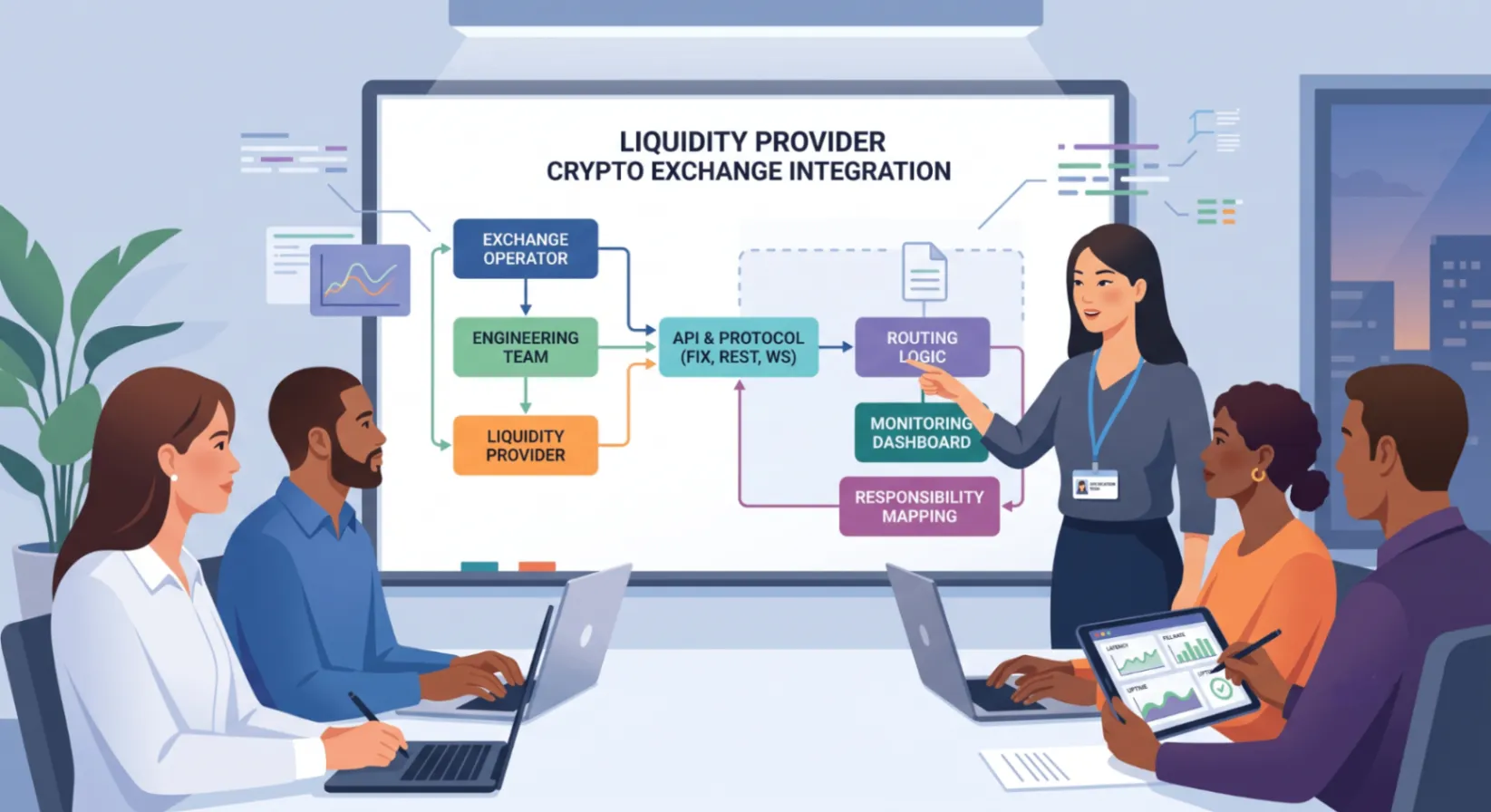
By the time an exchange operator has selected a liquidity provider, there's usually a sense that the hard part is done, the commercial terms are agreed, the relationship is set. But the technical integration between the exchange and that liquidity provider is its own project, and it's one that goes much more smoothly when the operator briefs their engineering team clearly upfront, covering the same ground we detail in crypto liquidity solutions: the routing, controls, and monitoring infrastructure, rather than leaving them to reverse-engineer requirements from a signed term sheet.
Start With the Provider's Actual API and Protocol
Every liquidity provider connects differently: some offer a FIX protocol connection, others a REST or WebSocket API, and the specifics of order types, fill reporting, and rate limits vary considerably. The engineering team needs the provider's actual technical documentation early, not a summary, and enough lead time to understand its quirks before building against it.
Brief the Routing Requirements Clearly
The engineering team needs to know exactly how order flow should reach the liquidity provider: is all flow routed to this one provider, or does the exchange need routing logic that can split flow across multiple providers, and if so, based on what criteria (price, historical fill quality, provider-specific limits)? Operators should also clarify what should happen to an order if the connection to the provider drops mid-flow, since building that failure handling in from the start is far cheaper than discovering the gap during a live outage, part of the trading infrastructure work we scope for regulated exchanges.
Define What "Monitoring" Needs to Show
Different stakeholders care about different things when it comes to monitoring a liquidity connection. A finance or operations team typically wants visibility into fill rates and realized spread versus quoted spread. A technical team wants latency, connection uptime, and data-feed integrity. An operator briefing engineering on this integration should specify which of these matter most for this particular relationship, so the monitoring layer is built to answer the actual questions that will get asked once the connection is live.
Clarify Where Responsibility Sits
This is the briefing point operators skip most often, and it causes confusion later: who is responsible for what once the integration is live? The engineering team is typically responsible for the connections, controls, and monitoring surface, the actual plumbing and the tools to manage it, exactly the split we describe on our about page. The liquidity provider is responsible for the quotes themselves, spread behavior, and fill quality, that's a commercial relationship the operator manages directly, the same two-contract distinction we cover in crypto market making services: why the contracts are different. Being explicit about this split before the integration is built means that when something goes wrong later, a wide spread versus a dropped connection, everyone already knows which conversation to have and with whom.
Give Engineering Room to Build Controls, Not Just Connections
It's common for an integration brief to focus entirely on "connect us to this provider" and skip the controls layer entirely, only for the operator to discover months later that they have no way to pause the connection, adjust routing, or redirect flow without an emergency engineering request. Briefing the team upfront to build real operator-facing controls, not just a working pipe, saves that scramble later and gives the operator actual agency over a relationship they're financially accountable for.
Plan for Change From the Start
Liquidity provider relationships aren't always permanent. Terms get renegotiated, providers get added, and sometimes relationships end. An engineering team briefed to build a provider-agnostic integration, rather than one hard-coded tightly to a single provider's specific API, gives the operator far more flexibility if any of that happens. If you're planning this kind of integration, our team can walk through what a provider-agnostic build looks like for your setup.