
Smart Contract Maintenance and Upgrades: The Development Service Most Firms Skip
September 8, 2026
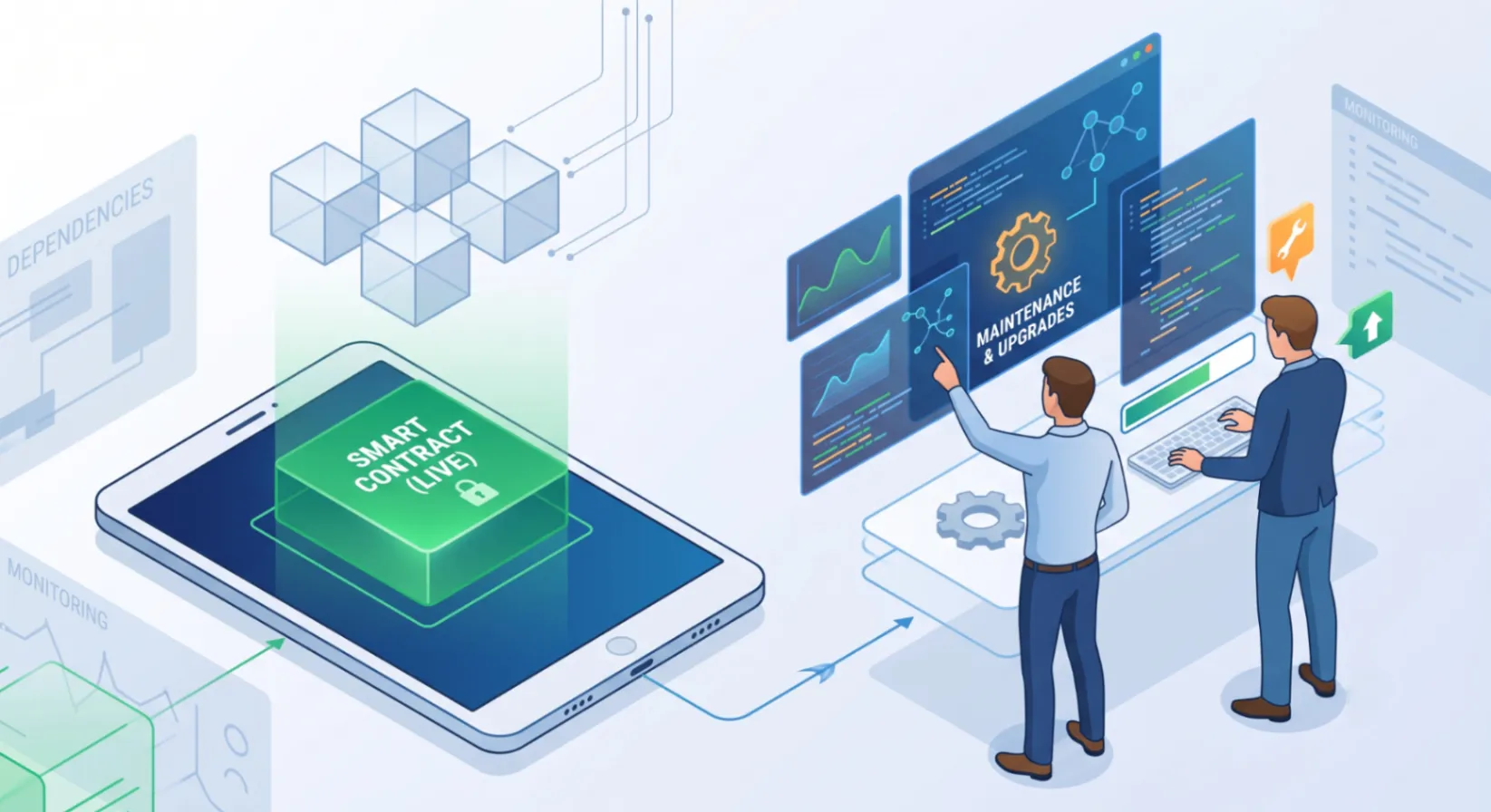
Most conversations about smart contract development services end at mainnet deployment, as if shipping the contract is the finish line. It isn't. A contract that goes live is the start of a maintenance relationship, whether or not anyone planned for one, and the firms that treat maintenance as a real service rather than an afterthought, the way we describe in our stage-by-stage breakdown of smart contract development services, tend to produce contracts that hold up better over time.
Why Maintenance Gets Skipped
It's easy to see why this happens. Maintenance is harder to scope upfront than a build, it's less visible in a sales conversation, and many teams simply assume "deployed" means "done." But smart contracts operate in an environment that keeps moving after launch: new vulnerability classes get discovered across the industry, dependent protocols change their interfaces, gas dynamics shift, and business requirements evolve in ways the original contract wasn't designed for. A contract with no maintenance plan is a contract that quietly accumulates risk the longer it sits untouched, the same kinds of risk we walk through in common smart contract vulnerabilities and how audits catch them.
What "Maintenance" Actually Covers
Real maintenance for a deployed contract usually includes a few distinct activities. Monitoring covers watching the contract's on-chain behavior for anything unexpected, unusual call patterns, failed transactions that shouldn't be failing, or interactions with a newly-flagged risky counterparty contract. Dependency tracking means staying aware of changes in any external contracts or oracles the deployed contract relies on, since a dependency that changes behavior can break integration logic even when the contract itself hasn't been touched. And patch or upgrade planning covers what happens when a fix or feature addition is actually needed, which is where upgrade architecture decisions made at the original design stage start to matter a great deal.
Upgrade Patterns and Why They're Decided Early
Whether a contract can be upgraded at all, and how, is an architecture decision, not something bolted on later. Immutable contracts offer the strongest security guarantee, since there's no upgrade mechanism to compromise, but they mean any bug or needed change requires a full migration to a new contract. Proxy-based upgrade patterns allow logic to be swapped without migrating state or user balances, but they introduce their own attack surface around who controls the upgrade and how that control is secured. Neither approach is universally correct; the right choice depends on how much the contract's requirements are expected to change, and how the choice affects overall cost is part of what we cover in what a smart contract development company actually charges.
Why Ownership and Key Control Terms Matter Here
Maintenance only works cleanly when everyone agrees, in writing, on who controls what. That means settling smart-contract ownership, deployment-key control, and IP terms before work starts, not after a maintenance need arises and everyone has to figure out on the spot who has the authority to push a fix. This applies whether the maintenance work continues with the original development firm, moves in-house, or moves to a different vendor entirely. A clean handover document, spelling out deployment keys, admin roles, and upgrade authority, is worth far more after six months in production than it seems worth on signing day. Our services page outlines how we build this into every engagement from the start.
What to Ask a Development Firm About Maintenance
Before committing to a build, it's worth asking directly what happens after deployment. Is there a monitoring service, or is the client expected to watch the contract themselves? If a vulnerability is discovered in a pattern the contract uses, industry-wide, not specific to this contract, does the firm proactively flag it, or is that the client's job to track? And if an upgrade is needed later, is the original team available for that work, and on what terms? A firm that has good answers to these questions, and that built upgrade strategy into the architecture from day one, is signaling that it thinks about a contract's whole lifecycle, not just the deployment event. If you'd like to talk through a maintenance plan for an existing contract, get in touch.