
Crypto Liquidity Solutions: The Routing, Controls, and Monitoring Infrastructure Behind Exchange Integrations
September 8, 2026
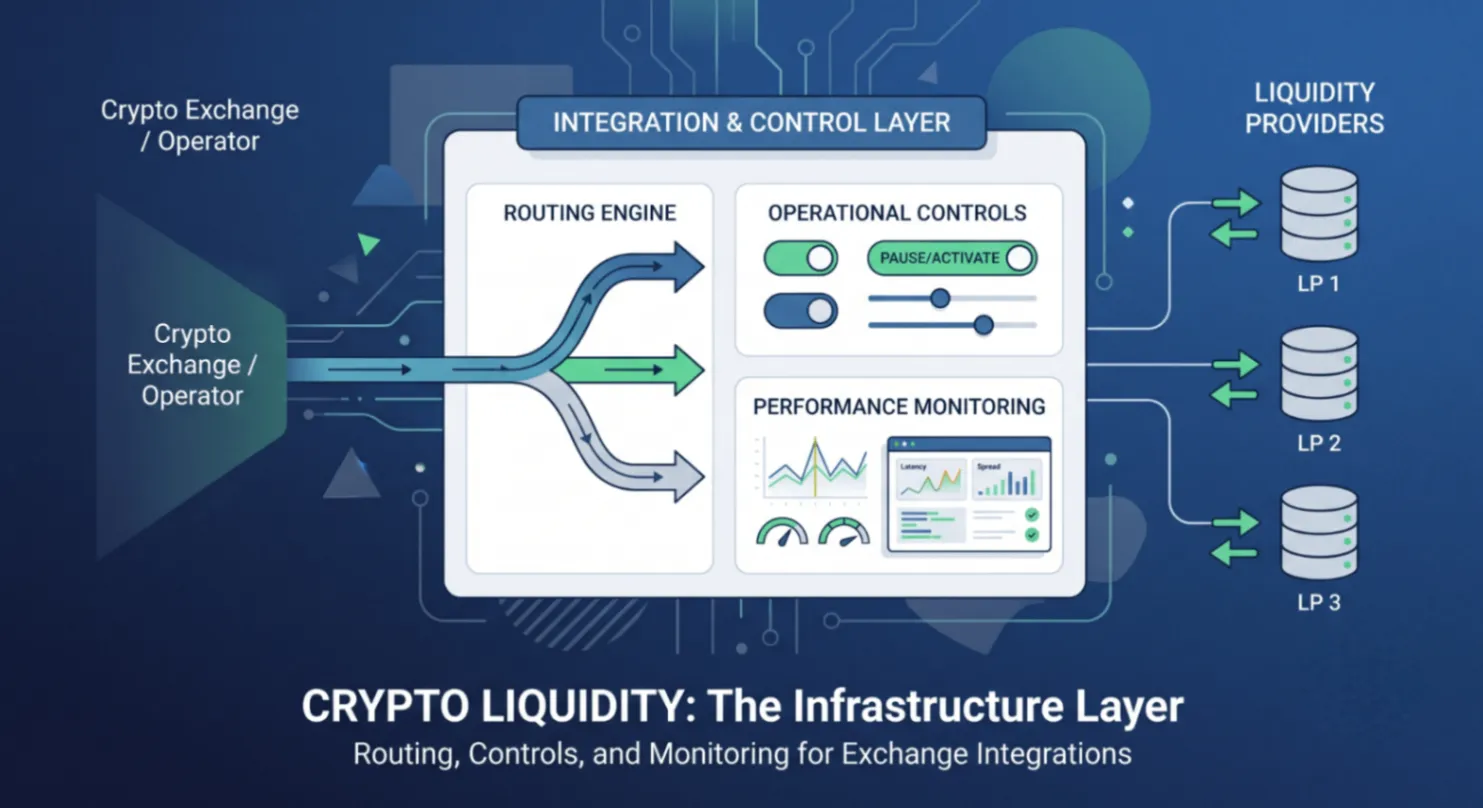
When people talk about crypto liquidity solutions, the conversation usually jumps straight to the commercial question: which liquidity provider, what spreads, what depth. Those are real questions, but they sit on top of something that gets much less attention: the engineering infrastructure that actually connects an exchange or token program to a liquidity source in a reliable, monitored, controllable way, the layer we build as part of our exchange and trading infrastructure services. That infrastructure is its own discipline, separate from the liquidity relationship itself, a distinction we unpack further in crypto market making services: two different contracts.
Liquidity Is a Relationship, Integration Is an Engineering Problem
It's worth separating these clearly. The liquidity relationship, who is quoting both sides of a market and taking on inventory risk, is a commercial and financial arrangement between an operator and a liquidity provider. The integration, how that provider's quotes and fills actually connect into an exchange's order book or a token's trading venue, is an engineering problem: routing logic, API connections, data pipelines, and a control layer that lets an operator actually manage the connection day to day. An operator can have excellent commercial terms with a liquidity provider and still suffer from a badly built integration layer, or vice versa.
What Routing Actually Involves
Routing logic determines how order flow reaches a liquidity provider and how fills come back. Done well, this means the exchange or platform can direct flow appropriately, handle partial fills gracefully, and fail predictably if a provider's connection drops rather than silently losing orders or double-processing them. This is not a trivial integration; it requires careful handling of state, retries, and edge cases around partial execution, all of which matter more as trading volume grows, the same considerations that shape what we build for regulated exchange trading tools.
Controls: What an Operator Actually Needs to Be Able to Do
A liquidity integration without a real controls layer forces an operator to trust that everything is working correctly with no way to intervene if it isn't. A proper controls layer gives an operator the ability to pause a connection, adjust routing rules, or redirect flow away from a provider that's underperforming, without needing to renegotiate the underlying commercial relationship or wait on an engineering team to make a code change under pressure.
Monitoring: Seeing What's Actually Happening
Monitoring for a liquidity integration should surface the things that actually indicate whether the arrangement is working: fill rates, realized spread versus quoted spread, latency between quote and fill, and any gaps or anomalies in the data feed itself. Without this visibility, an operator is relying entirely on the liquidity provider's own reporting to know whether the relationship is delivering what was agreed. This is exactly the kind of brief we recommend operators give their engineering team when integrating a liquidity provider.
Why Provider-Agnostic Design Matters
One of the more overlooked engineering decisions in a liquidity integration is whether it's built specifically around one provider's API, or designed as a general-purpose layer that can connect to a different provider later with less rework. Operators who expect to work with a single liquidity provider indefinitely may not prioritize this, but for anyone who anticipates adding a second provider, switching providers, or running multiple liquidity relationships across different venues, provider-agnostic routing and monitoring infrastructure pays for itself the first time a provider relationship changes.
The Operator's Role in This Model
In this framing, the engineering team builds and maintains the connections, controls, and monitoring surface, while the operator is the one who appoints and contracts with the actual liquidity provider, exactly as we describe on our about page. That division of responsibility keeps accountability clean: a spread that's too wide or a provider that's underdelivering is a conversation with the liquidity provider directly, while a dropped connection or a monitoring discrepancy is an engineering conversation. If you're evaluating crypto liquidity solutions for an exchange or token program, reach out and we can walk through what the integration layer would look like.