
Building Trading Tools for Regulated Crypto Exchanges: What the Engineering Work Actually Involves
August 6, 2026
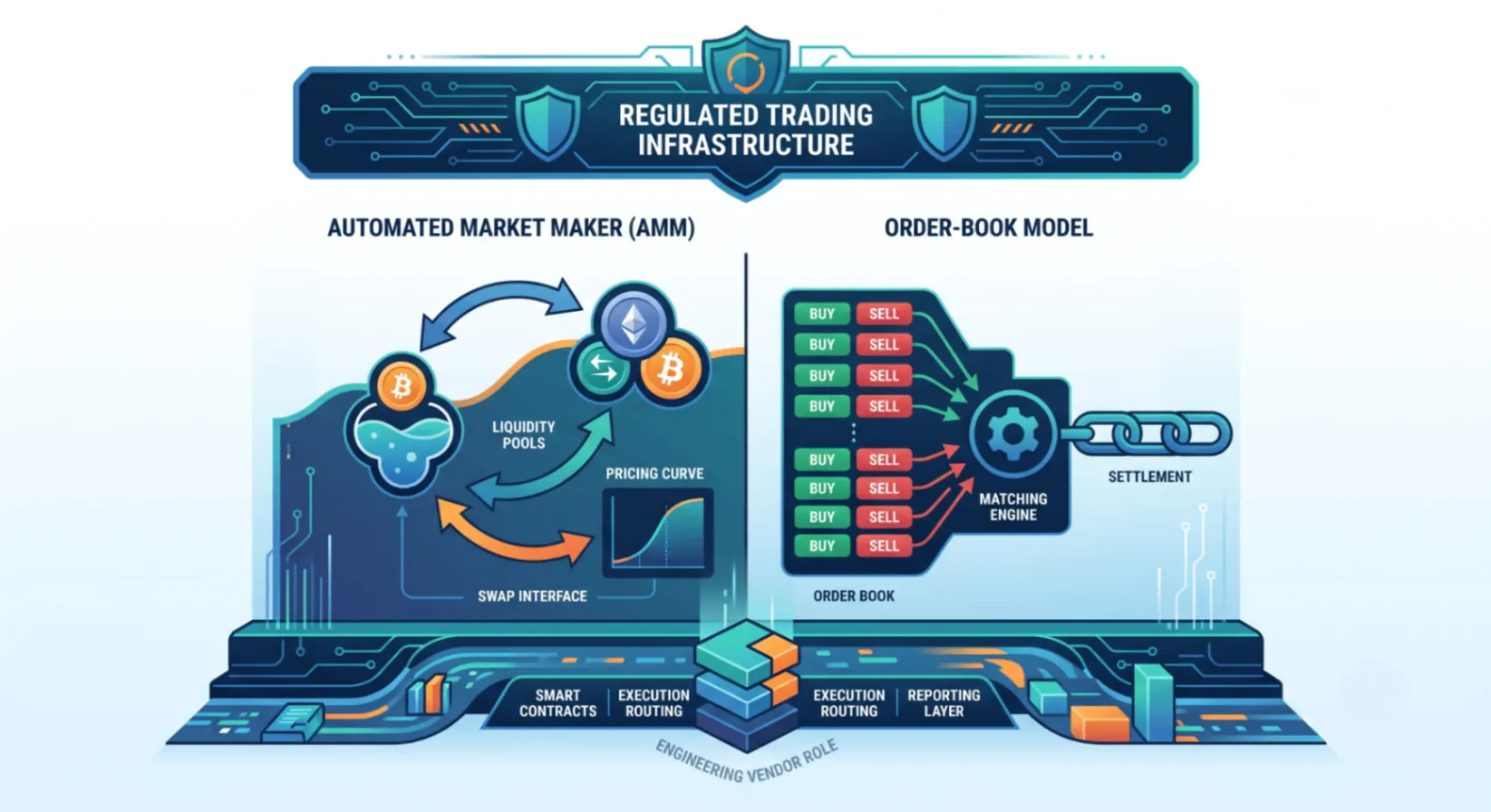
“We need trading tools built” is a common opening line, but it covers an enormous range of actual scope — from a single-pair swap interface to order-book matching, execution routing, and the reporting layer a licensed venue needs to satisfy its supervisor. This post breaks down what a complete trading-infrastructure engagement typically includes, what a realistic delivery timeline looks like, and what to expect from an engineering vendor at each stage.
One scoping note before the detail. Dapplication Tech builds and maintains software. We are a technology supplier, not a licensed venue, and we do not operate exchanges, hold client assets, execute orders, provide liquidity, or make markets. Where the sections below discuss liquidity or execution, they describe the systems an operator needs built — the operator, not us, carries the licence and the regulatory obligations attached to running them.
Defining the Model Before Anything Else
Before any development starts, the first real decision is which exchange model the DEX will use — an automated market maker (AMM), an order-book model, or a hybrid of the two. This decision affects nearly every downstream choice, from smart contract architecture to how liquidity needs to be sourced, and it’s covered in more depth in our comparison of order book versus AMM models. For scoping purposes, it’s enough to know this decision happens first, because it determines the shape of everything that follows.
Component 1: Core Smart Contracts
This is the foundation — the contracts governing how swaps execute, how liquidity pools are created and managed (for AMM models), or how orders are matched (for order-book models). For an AMM-based DEX, this typically includes the pool factory contract, the individual pool contracts implementing the pricing curve, and router contracts that handle multi-hop swaps across pools when a direct trading pair doesn’t exist. For an order-book model, this includes the matching engine logic, order storage, and settlement contracts.
This component follows the same rigorous development process as any smart contract engagement: specification, architecture, development against frameworks like Foundry or Hardhat, internal testing including fuzzing, and external audit before mainnet — all detailed in our breakdown of what smart contract development services include end to end.
Component 2: Liquidity Integrations
A DEX with no liquidity is just a website. This component covers how the exchange sources and manages liquidity, which varies significantly depending on the model and the project’s stage. For a new AMM-based DEX, this often means building incentive mechanisms — liquidity mining programs that reward early liquidity providers with governance tokens or fee shares — and integrating with liquidity aggregation protocols so the DEX’s rates stay competitive even before organic liquidity is deep. For projects that need active liquidity from day one rather than waiting for organic growth, the operator will typically appoint an authorised liquidity provider; our scope in that case is building the integration and monitoring surface the arrangement runs on, not the provision of liquidity itself.
Component 3: Front-End Trading Interface
Beyond the smart contracts, users need an interface for swapping, providing liquidity, and (for order-book models) placing and managing limit orders. This typically includes real-time price charts, a swap interface with slippage tolerance settings, a liquidity provision dashboard showing pool share and accrued fees, and wallet connection supporting multiple wallet providers. Performance matters disproportionately here — traders are sensitive to interface lag in a way typical web app users aren’t, since a slow quote refresh can mean executing a trade at a worse price than displayed.
Component 4: Indexing and Analytics Infrastructure
DEXs generate enormous volumes of on-chain events — every swap, every liquidity addition or removal, every fee accrual. Making this data usable in the front end (trading volume charts, pool TVL over time, individual user trade history) requires indexing infrastructure, typically built using The Graph or a comparable indexing solution, structured specifically around the DEX’s event schema.
Component 5: Security Audit and Testnet Staging
Given that a DEX directly custodies user funds in liquidity pools and handles continuous financial transactions, this component gets particular emphasis. Beyond a standard smart contract audit, DEX-specific audits look closely at pricing curve manipulation risks, flash loan attack vectors against the pool logic, and edge cases in multi-hop routing that could be exploited to extract value unfairly from other traders. Testnet staging for a DEX typically runs longer than for a simpler dApp, since simulating realistic trading volume and liquidity conditions takes more deliberate setup.
A Realistic Delivery Timeline
Based on projects we’ve scoped and delivered, a reasonable range by complexity:
- Basic single-chain AMM DEX (standard constant-product pools, straightforward swap and liquidity provision UI): 10–14 weeks
- Multi-chain or hybrid AMM/order-book DEX with liquidity aggregation across pools: 16–22 weeks
- Full order-book DEX with off-chain matching engine and on-chain settlement: 20–28 weeks, given the added complexity of the matching infrastructure and the more rigorous audit scope it typically requires
These ranges assume the exchange model decision is locked before development begins — projects that start building before settling on AMM versus order-book architecture routinely see significant rework once that decision is finalized mid-project.
Milestones Worth Building Into the Contract
A well-scoped engagement should have clearly defined milestones rather than a single “done” date at the end. A typical milestone structure includes: specification and architecture sign-off, core contract development complete and passing internal tests, external audit complete with findings remediated, testnet deployment with front-end integration, and production launch with the operator’s own liquidity arrangements in place. Tying payment schedules to these milestones, rather than a single lump sum at the end, gives both sides clearer checkpoints and reduces the risk of a project running significantly over budget before either party notices.
Ask for Named References, Not Adjectives
You should feel comfortable asking an engineering vendor which specific systems they have shipped and which audit firms reviewed the code, and you should expect specific names in response rather than vague references to “top-tier auditors” or “enterprise-grade” work. A vendor with genuine delivery history will have real, nameable projects and won’t hesitate to share them — including, where appropriate, a reference from a past client. Our own delivery history includes the KimlWallet and DokWallet non-custodial wallets, the KimlCards issuing programme, exchange tooling for Kimel Exchange, and marketing and reporting platforms for 47 Yards and Masterclick. Several of these are companies within our own group, and we say so rather than presenting them as arm’s-length client wins.
Component 6: Governance and Fee Structure (Where Applicable)
Many DEXs, particularly those aiming for a decentralized or community-governed model over time, include a governance layer — typically a token that grants voting rights over parameters like trading fees, which pools receive liquidity mining incentives, or treasury allocation. If this is part of the roadmap, it’s worth scoping explicitly, because governance contracts bring their own security considerations distinct from the core swap and pool logic, including protections against flash-loan-based voting manipulation, where an attacker borrows a large token position purely to swing a vote before returning the loan in the same transaction. Not every DEX needs on-chain governance at launch — many reasonably start with a more centralized fee and parameter structure and decentralize progressively — but it should be a deliberate decision made during scoping, not an assumption either way.
What “Post-Launch” Actually Looks Like for a DEX
Unlike a simpler dApp, a DEX doesn’t reach a stable steady state at launch — trading volume, liquidity depth, and pool composition are all in constant flux, and this has real implications for what post-launch support needs to cover. Ask a prospective vendor specifically about: monitoring for abnormal trading patterns that might indicate an exploit attempt in progress, a defined process for adding new trading pairs or pools after launch (does this require a new audit pass, or is it covered under the original audit scope if it uses the same underlying contract logic), and whether the vendor offers ongoing support for liquidity mining program administration if that’s part of the model. DEXs also tend to attract more sophisticated adversarial attention than the average dApp, given the value concentrated in liquidity pools, so a vendor’s post-launch monitoring and incident-response capability deserves the same scrutiny as their initial development process.
Cost Ranges Worth Knowing Going In
While exact pricing varies significantly by vendor, chain, and scope, founders evaluating quotes should expect a basic single-chain AMM DEX to run into six figures once audit costs, liquidity mining contract development, and a proper testnet staging period are included — quotes significantly below that range are worth scrutinizing closely for what’s actually excluded. Multi-chain and order-book models scale up from there given the added architectural and audit complexity described above. Getting a detailed, component-by-component breakdown from any vendor, rather than a single bottom-line number, is the best way to sanity-check whether a quote reflects the full scope described in this post or has quietly left pieces out.
What This Means for Your Scoping Conversations
When you sit down with an engineering vendor, expect the conversation to move through model selection, then each of the five components above, before landing on timeline and cost. A vendor who jumps straight to a fixed quote without walking through this sequence is likely underscoping the project, and the gap will surface later — either as scope creep or as a venue that’s missing infrastructure (indexing, reporting, audit depth) that only becomes obvious once real users and real volume arrive.