
In-House Team vs a dApp Development Company: When Outsourcing Actually Makes Sense
September 8, 2026
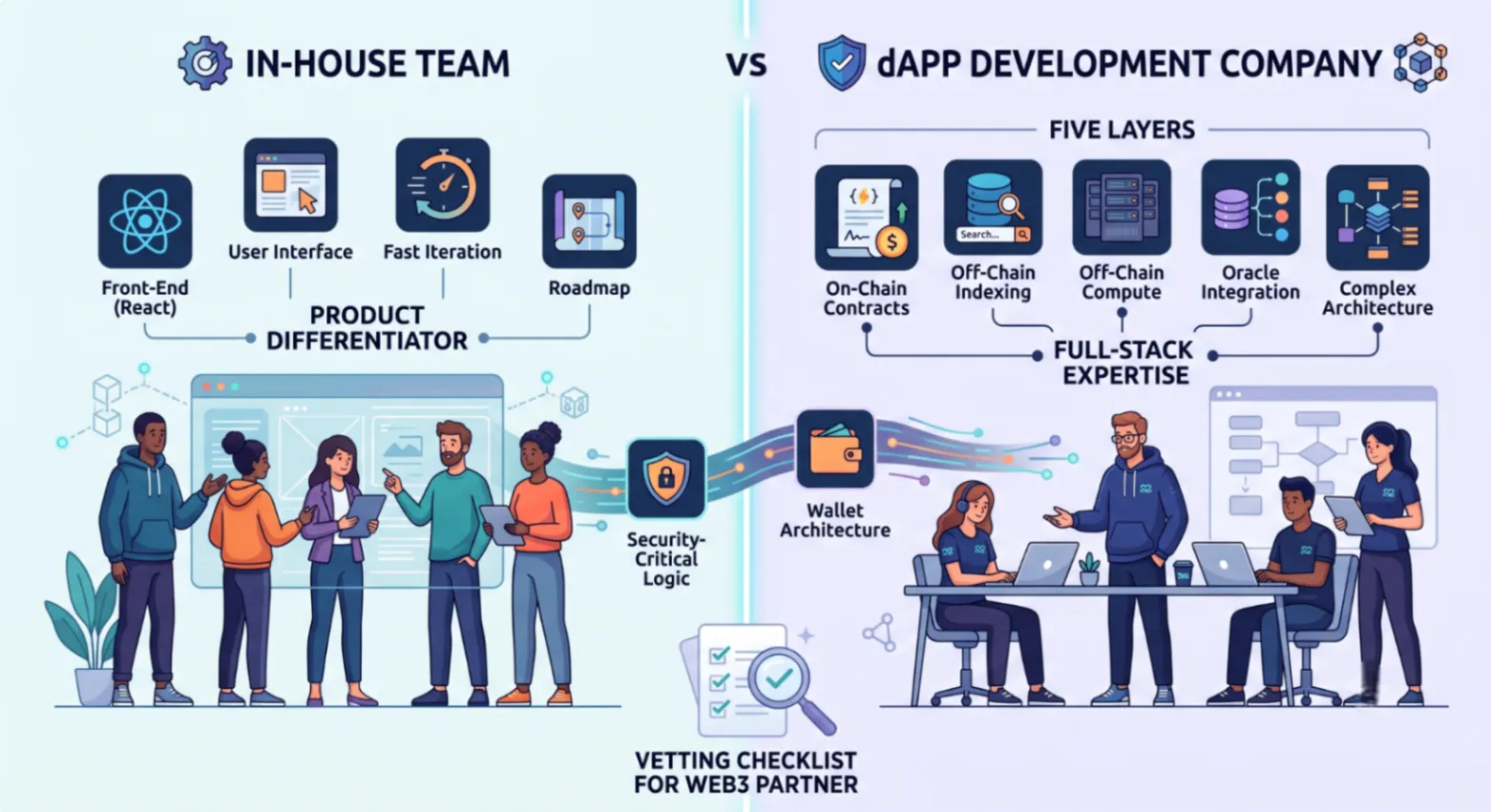
Every founder building a dApp eventually asks the same question: hire people, or hire a firm. There is no universally correct answer, but there is a useful way to think about it, which is to look at what a dApp actually requires across its full stack, as we cover in dApp Architecture 101, and be honest about which of those layers your team can genuinely staff versus which ones you would be learning on the job.
The Five Layers a dApp Actually Needs
A modern dApp is not just a smart contract with a front end bolted on. It typically spans five layers: on-chain contracts that hold the core logic and state, off-chain indexing that makes on-chain data queryable at speed, off-chain compute and backend services that handle everything a contract shouldn't do on-chain, oracle integration that brings external data on-chain reliably, and the front end that users actually touch. Each layer has its own failure modes and its own specialist skill set, the kind we detail on our services page. A team that is strong in front-end React work is not automatically strong in gas-efficient Solidity, and a team that can write a secure contract is not automatically equipped to run production indexing infrastructure at scale.
Where In-House Makes Sense
Building in-house works best when the product itself, not just its blockchain component, is the core differentiator and needs continuous, fast iteration by people who deeply understand the business logic. It also makes sense when a team already has a strong general engineering base and just needs to build blockchain-specific skills over time, and the timeline allows for that learning curve without risking a launch date. Teams that expect to maintain and extend the dApp for years often benefit from having that expertise permanently in-house rather than re-engaging outside help for every change.
Where Outsourcing to a dApp Development Company Makes Sense
Outsourcing tends to make more sense when a team needs all five layers built correctly on a fixed timeline and doesn't have deep experience across all of them simultaneously. It's also the better fit when the project needs specific expertise that's expensive to hire for a single build. Non-custodial wallet architecture is a good example, where getting key generation, storage, and multi-chain support wrong has real consequences for users, and where getting it right benefits from a team that has already shipped a non-custodial wallet in production. A development company that has delivered non-custodial wallets brings pattern-matching from real deployments: what actually breaks in production, which integration points get missed, and how to structure the API layer so it holds up under real usage.
The Hybrid Path Most Teams Actually Take
In practice, few teams pick a pure in-house or pure outsourced path. A common middle ground is to bring in a development company for the layers where mistakes are costly and hard to reverse, contract architecture, security-critical logic, and wallet or custody design, while keeping product-specific front-end and business-logic work in-house where the team's domain knowledge matters most. This also gives an in-house team a chance to absorb some of the outside team's practices over time, rather than treating the engagement as a one-off black box. Our own checklist for vetting a full-stack Web3 development company is a useful starting point for structuring that hybrid relationship.
Questions That Clarify the Decision
Before deciding, it helps to ask a few honest questions internally: which of the five layers does our team already have direct production experience with, not adjacent experience, but the specific thing (gas optimization, oracle integration, key management); what is the cost of getting one of these layers wrong after launch, versus the cost of paying for outside expertise now; and how long do we expect to maintain and evolve this dApp, since a six-month build with no planned iteration has different staffing logic than a product meant to run and grow for years.
There isn't a universal right answer here, but there is a wrong way to decide: assuming that because a team can build software well in general, it can build all five layers of a dApp well specifically. The layers that carry the most risk if mishandled, contract security and custody architecture in particular, are worth watching for the red flags that show up when a vendor hasn't actually done this work before, and are usually the ones worth the most scrutiny when making this call.