
dApp Architecture 101: Smart Contracts, Front End, and Off-Chain Infrastructure
August 6, 2026
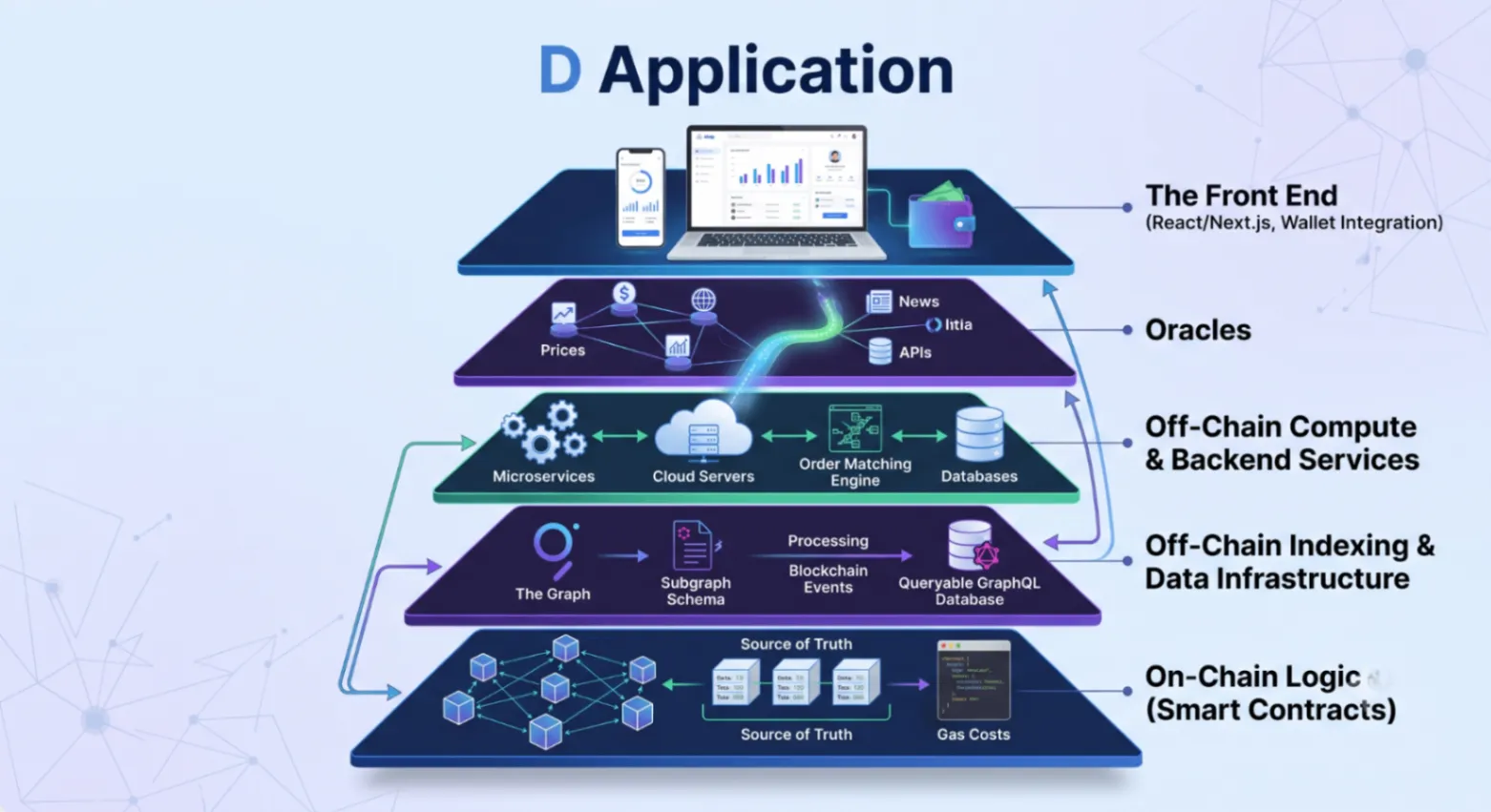
Founders new to blockchain development often picture a dApp as “a website plus a smart contract” — which is directionally right but leaves out most of the pieces that actually make a modern decentralized application usable, fast, and reliable at scale. A production dApp is really a layered system, and understanding those layers helps founders ask better questions during vendor scoping and better understand where their budget is actually going.
Layer 1: On-Chain Logic (Smart Contracts)
This is the layer most people think of first, and it’s the source of truth for anything that needs trustless, verifiable execution — token balances, ownership records, governance votes, financial logic like lending or trading. Smart contracts run deterministically on the blockchain itself, meaning every node in the network executes the same code and arrives at the same result, which is what gives blockchain-based systems their core property of not requiring a trusted intermediary.
The trade-off is cost and speed: every write to this layer costs gas and takes time to confirm, which is precisely why not everything in a dApp lives here. Well-architected systems are deliberate about what absolutely must be on-chain — anything involving fund custody, ownership, or logic that needs to be publicly verifiable — versus what can live in layers below, which are faster and cheaper but don’t carry the same trustless guarantees.
Layer 2: Off-Chain Indexing and Data Infrastructure
Reading data directly from a blockchain node is technically possible but impractical for most application needs — querying “show me all NFTs owned by this address” or “show me this user’s full transaction history” by scanning raw blockchain data would be prohibitively slow. This is the problem indexing infrastructure solves.
The Graph has become the de facto standard indexing solution in the EVM ecosystem: developers define a “subgraph” — a schema describing what on-chain events and data they want indexed — and The Graph’s infrastructure processes blockchain data into a queryable, structured format that a front end can request via GraphQL, typically returning results in milliseconds rather than the seconds or longer a raw node query would take. Most production dApps handling any meaningful amount of historical or relational data rely on an indexing layer like this rather than querying contracts directly for every page load.
Layer 3: Off-Chain Compute and Backend Services
Beyond indexing, many dApps need traditional backend infrastructure for things that don’t belong on-chain at all: user notification systems, off-chain order matching before a trade is settled on-chain, caching layers to reduce redundant blockchain queries, and API services that aggregate data from multiple sources (on-chain data, price feeds, off-chain databases) into a single response the front end can consume efficiently.
This layer looks much more like conventional web infrastructure — often built on standard cloud services — and its design directly affects how the application performs under load, independent of blockchain-specific bottlenecks.
Layer 4: Oracles (Bridging On-Chain and Off-Chain Data)
Smart contracts can’t natively access data from outside the blockchain — they have no built-in way to know the current price of ETH in USD, the outcome of a real-world event, or data from another blockchain entirely. Oracles solve this by feeding external data on-chain in a way smart contracts can trust and use. This layer is architecturally distinct from general off-chain infrastructure because it requires specific design consideration around manipulation resistance — a poorly designed oracle integration is one of the more common sources of exploits in DeFi specifically, as covered in more depth in our post on common smart contract vulnerabilities.
Layer 5: The Front End
This is the layer users actually see and interact with, typically built using standard modern web frameworks — React and Next.js remain the dominant choice for production dApps. What makes a dApp front end architecturally distinct from a typical web app is wallet integration: the front end needs to detect and connect to a user’s wallet (via libraries like wagmi, viem, or ethers.js), construct and submit transactions for the user to sign, and handle the full range of states a blockchain transaction can be in — pending, confirmed, failed, or stuck due to insufficient gas — in a way that gives users clear, real-time feedback rather than a spinner with no context.
Good dApp front ends also need to gracefully handle the reality that blockchain state can change between when a user loads a page and when they submit a transaction, which requires more careful state management than a typical web app where the backend is the single source of truth updated synchronously.
How These Layers Fit Together in Practice
A concrete example makes this easier to visualize. Consider a decentralized marketplace where users can list and buy NFTs:
- Smart contract layer holds the actual listing and escrow logic — when a buyer purchases, the contract atomically transfers the NFT and releases payment, with no intermediary able to interfere with that transaction
- Indexing layer (via The Graph or a comparable indexer) tracks every listing, sale, and price history event emitted by the contract, making it possible for the front end to instantly display “recently sold” or “price history” without querying the chain directly for every request
- Off-chain backend might handle things like image/metadata caching (since NFT images typically live off-chain, referenced by a URL stored on-chain), search functionality, and user notification when an item they’re watching sells
- Oracle layer might feed in real-time ETH/USD pricing so the front end can display listing prices in familiar currency terms alongside the on-chain ETH-denominated price
- Front end ties it all together: wallet connection, transaction construction for listing or buying, and a responsive interface pulling from the indexer for fast reads and the contract directly for writes
A Simple Way to Visualize the Stack
It can help to think of these five layers as a vertical stack, each one trading off trust guarantees against speed and cost as you move down it:
- On-chain contracts — highest trust, slowest, most expensive per write
- Oracles — bridge trusted external data into the trusted on-chain layer, with careful design needed to avoid becoming the weakest link
- Indexing — fast, cheap reads of on-chain history, but not itself a source of truth — always ultimately verifiable against the chain
- Off-chain backend — fastest and most flexible, but carries no on-chain trust guarantees at all
- Front end — the presentation layer tying all of the above together for the end user
A well-architected dApp is deliberate about which layer owns which responsibility, rather than defaulting everything to the most trusted (and most expensive) layer out of caution, or conversely pushing too much off-chain in the name of speed and quietly reintroducing the kind of centralized trust dependency the application was meant to avoid in the first place.
Common Architecture Mistakes Worth Knowing About
A few patterns show up repeatedly in dApps that run into trouble post-launch. The most common is underinvesting in the indexing layer early on, then discovering that front-end load times are unacceptable once the user base and transaction history grow beyond what direct contract queries can handle gracefully — retrofitting an indexer after launch is possible but meaningfully more work than architecting for it from the start. A second common mistake is treating oracle integration as an afterthought bolted on late in development, rather than a first-class architectural decision made alongside the smart contract design itself, since the oracle’s manipulation resistance directly affects the security guarantees of any contract logic that depends on it. A third is under-engineering transaction-state handling on the front end, leaving users staring at ambiguous loading states during the (sometimes lengthy) window between submitting a transaction and it being confirmed on-chain — a UX gap that disproportionately drives user drop-off compared to almost anything else in the stack.
What This Means for Scoping a Project
Understanding this layered structure changes how founders should think about a dApp development quote. A vendor quoting only for “smart contracts and a front end” without discussing indexing infrastructure, oracle integration where relevant, or off-chain backend needs may be underscoping the project — not necessarily dishonestly, but because these layers are easy to underestimate until a project is far enough along that the gaps become obvious. When evaluating a dApp development company, it’s worth asking directly which of these five layers they have hands-on delivery experience with, since fluency in smart contracts alone doesn’t guarantee the same depth on indexing architecture or production-grade front-end wallet integration — two areas that disproportionately affect how a dApp actually feels to use once it’s live.