
Decentralized Exchange Development: The Security Audit Checklist From Testnet to Mainnet
September 8, 2026
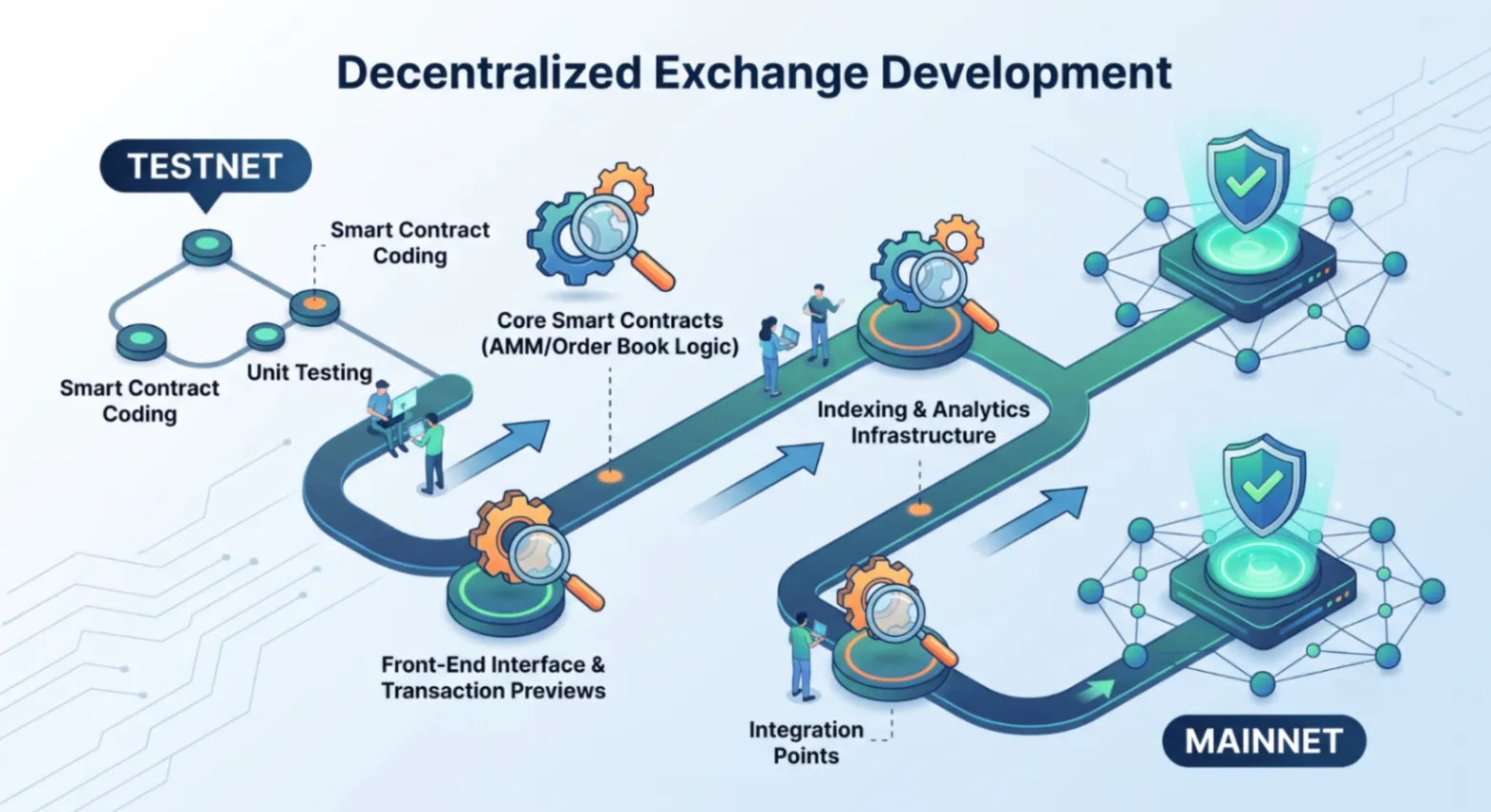
Decentralized exchange development carries a wider security surface than a single smart contract project, because a DEX isn't one contract, it's a system: core trading contracts, a front end that has to represent on-chain state accurately, indexing infrastructure that makes activity queryable, and the integrations that connect it all together, the components we deliver as part of our exchange and trading infrastructure work. A useful way to think about the audit process for a DEX is to walk the same path the system takes from testnet to mainnet, checking a different layer at each stage.
Core Smart Contracts First
The trading logic itself, whether it's an AMM pool, an order-book matching engine, or a hybrid model as we compare in Order Book vs AMM, is the highest-stakes component, since it directly controls user funds. This is where a structured audit needs to look hardest at the vulnerability classes that matter most for exchange logic specifically: reentrancy in swap or withdrawal functions, price-oracle manipulation if the DEX relies on any external price feed, access-control flaws around admin functions like fee changes or pool creation, and front-running exposure in how transactions are ordered and executed, the same vulnerability classes we cover for smart contracts generally. Getting this layer wrong is the most expensive kind of mistake to make on a DEX, because it's the layer attackers target first.
The Front-End Trading Interface
A DEX's front end isn't just a UI convenience, it's the layer users trust to represent what's actually happening on-chain. An audit pass here should check that the interface accurately reflects contract state, that transaction previews (expected output, slippage, fees) match what the contract will actually execute, and that the interface can't be tricked into submitting a transaction the user didn't intend to approve. Front-end bugs on a DEX don't just create a bad user experience, they can lead users to sign transactions that do something different from what they saw on screen.
Indexing and Analytics Infrastructure
Most DEX users and integrators never interact with the raw chain directly, they see whatever the indexing layer surfaces: trade history, pool balances, price charts, volume data. If this layer is wrong or lags badly, it undermines trust in the platform even when the underlying contracts are perfectly secure. Security review here focuses less on funds at risk and more on data integrity and availability, making sure indexed data actually matches on-chain state and that the indexing service itself isn't a single point of failure that can take the whole platform's visible data offline. This is one of the reasons ownership and control of the delivered system matters, something we detail in choosing a DEX development company.
Security Audit Through Testnet Staging
This is where everything gets exercised together before real capital is at risk. A meaningful testnet stage for a DEX means more than deploying the contracts and clicking through the UI once. It means simulating realistic trading volume, testing edge cases like extremely small or large trade sizes, checking behavior when a pool is drained close to empty, and confirming that the front end and indexing layers behave correctly under load, not just under a clean demo scenario. Testnet staging is also the point where any gas-cost surprises or timing issues in the matching or settlement logic tend to surface, before they become expensive lessons on mainnet, and the same stage-by-stage discipline we apply on the trading tools we build for regulated exchanges.
What Changes Between AMM and Order-Book Models
The specific audit focus shifts depending on the exchange architecture. AMM-based DEXs need particular attention on pool math, impermanent loss mechanics, and how the contract handles edge cases at the extremes of a pool's balance. Order-book and hybrid models need closer scrutiny of matching logic, how orders are prioritized, and how the system behaves under high order volume or attempted manipulation of the order book itself. Neither model is inherently safer, but they fail in different ways, and a checklist that treats every DEX the same regardless of architecture will miss model-specific risks.
Mainnet Deployment and What Comes After
Deploying to mainnet isn't the end of the security process for a DEX any more than it is for a single contract. Ongoing monitoring for unusual trading patterns, unexpected pool imbalances, or interactions with newly-identified risky contracts should continue after launch, and any dependency the DEX relies on, an oracle, a bridge, an external price feed, needs to stay on the team's radar. Walking through security testnet-to-mainnet, layer by layer rather than treating "the audit" as one undifferentiated step, is what separates a DEX launch that holds up under real trading conditions from one that looks fine in a demo and breaks under its first real stress test.