
Order Book vs AMM: Exchange Architecture Models Compared
August 6, 2026
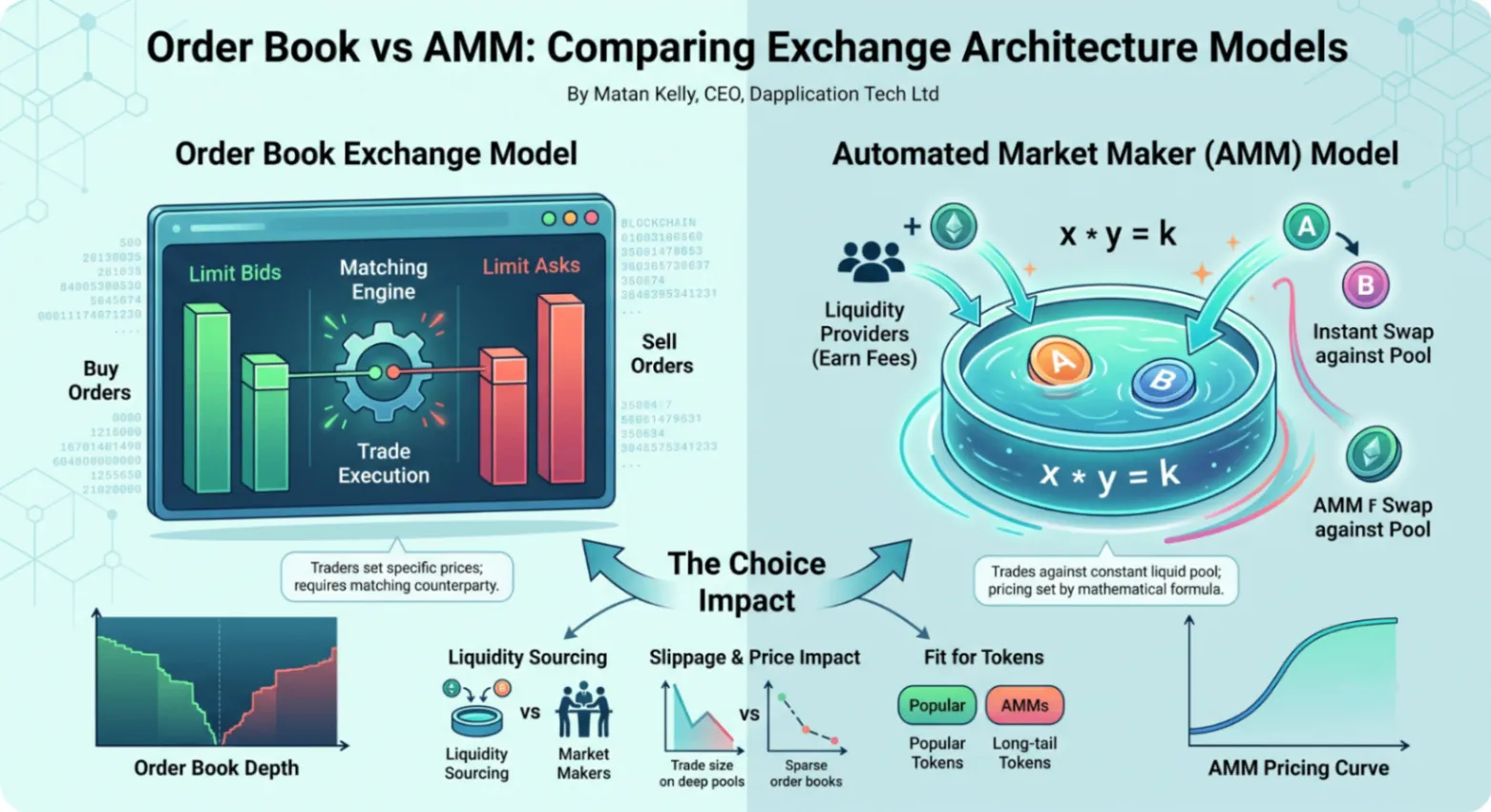
The choice between an order-book model and an automated market maker (AMM) model is the single most consequential decision in any decentralized exchange development project. It shapes the smart contract architecture, determines how liquidity needs to be sourced, and directly affects the trading experience users will have. This post compares the two models on the dimensions that actually matter for founders making this call — liquidity behavior, slippage, and fit with different token economics.
How AMMs Work
Automated market makers, popularized by Uniswap, replace traditional buy and sell orders with a mathematical formula that determines price based on the ratio of two assets held in a liquidity pool. Uniswap’s original design uses a constant-product formula (x × y = k), where the product of the two token quantities in a pool must remain constant — meaning any trade that adds one token to the pool necessarily removes some quantity of the other, with the price shifting continuously as the pool’s ratio changes. Liquidity providers deposit both assets into the pool and earn a share of trading fees proportional to their contribution.
This design’s biggest advantage is that liquidity is always available, at some price, for any pool that has been funded — there’s no need for a counterparty order to exist at the exact moment a trade is placed, unlike an order book. This is a major reason AMMs became the dominant model for long-tail tokens that would never attract enough active market makers to sustain a liquid order book.
How Order Books Work
Order-book DEXs, like dYdX, replicate the model familiar from traditional exchanges: buyers and sellers place limit orders at specific prices, and trades execute when a buy order and sell order match. In a fully on-chain order book, every order placement, cancellation, and match is a blockchain transaction — which historically made this model expensive and slow on Ethereum mainnet specifically. Most modern order-book DEXs address this by using an off-chain or hybrid matching engine (matching orders off-chain for speed, then settling the resulting trade on-chain for finality and custody security), or by building on chains and Layer 2s specifically optimized for the transaction throughput an order book requires.
The core advantage of an order book is price precision and control — traders can place a limit order at an exact price and know it will only execute at that price or better, which AMMs structurally cannot offer in the same way, since AMM prices move continuously as trades execute against the pool.
Slippage: A Direct Comparison
Slippage — the difference between a trade’s expected price and its actual execution price — behaves differently under each model, and this is often the most practical difference traders notice.
In an AMM, slippage is a direct mathematical function of trade size relative to pool depth. A trade that’s small relative to the pool moves the price only marginally; a trade that’s large relative to the pool can move the price substantially, which is why AMM interfaces typically show an estimated slippage percentage before a user confirms a trade, and why deep liquidity pools are specifically valuable for reducing slippage on larger trades.
In an order book, slippage occurs when a market order has to “walk the book” — filling against progressively worse-priced limit orders because there isn’t enough volume at the best price to fill the entire order. This means order-book slippage depends on the depth and density of resting limit orders at each price level, which in turn depends on how many active market participants are placing orders — a genuinely different liquidity dynamic than an AMM’s continuous pool-based pricing.
Published research on this comparison, including impermanent loss studies specific to constant-product AMMs, has consistently found that AMM slippage on shallow pools can exceed order-book slippage on comparably sized but well-populated order books — reinforcing that the “better” model for slippage is highly dependent on actual liquidity conditions, not an inherent property of either architecture.
Fit With Token Economics
This is where the decision often becomes clearer for a specific project. AMMs tend to be the better fit when a token is new, has limited existing trading activity, or needs to bootstrap liquidity from a community rather than professional market makers — the liquidity mining incentive structures common to AMM DEXs (rewarding liquidity providers with governance tokens) are specifically designed to solve the cold-start liquidity problem new tokens face. This is also why AMMs remain the dominant model for long-tail and newly launched tokens across the DeFi ecosystem.
Order books tend to be the better fit for established, high-volume trading pairs where professional market makers are willing to actively quote — which requires meaningful trading volume to justify the operational cost of active quoting on the provider’s side. Order books also tend to suit projects targeting more sophisticated traders who specifically want limit-order functionality and price precision that AMMs don’t offer.
Hybrid Models Are Increasingly Common
It’s worth noting that the distinction has blurred somewhat as the space has matured. Several DEXs now combine both models — offering an AMM pool as a liquidity backstop that’s always available, while layering an off-chain order book or request-for-quote system on top for traders who want tighter pricing and limit-order functionality when sufficient liquidity exists to support it. This hybrid approach is worth discussing explicitly with your engineering vendor if your project doesn’t cleanly fit the profile of either pure model.
Side-by-Side Summary
| Factor | AMM | Order Book |
|---|---|---|
| Liquidity availability | Always available if pool is funded, at some price | Depends on active orders at the desired price |
| Best suited for | New, long-tail, or community-bootstrapped tokens | Established, high-volume trading pairs |
| Price precision | No exact-price guarantee; price moves with trade size | Exact limit-price execution possible |
| Slippage driver | Trade size relative to pool depth | Order book depth at each price level |
| Development complexity | Generally simpler to build and audit | Higher, especially with off-chain matching components |
| Liquidity sourcing | Often community-driven via liquidity mining incentives | Typically requires active professional market makers |
| Capital efficiency for LPs | Varies by design (concentrated liquidity models improve this) | Market makers control capital deployment directly |
Capital Efficiency and Newer AMM Designs
It’s worth noting that AMM design itself has evolved considerably since the original constant-product formula. Newer designs — most notably concentrated liquidity, popularized by Uniswap v3 — allow liquidity providers to allocate their capital within a specific price range rather than across the entire theoretical price curve, significantly improving capital efficiency for pairs that trade within a predictable range. This narrows some of the historical gap between AMM and order-book capital efficiency, though it also adds complexity for liquidity providers, who now need to actively manage their price ranges rather than simply depositing and holding a position passively. Any DEX development scoping conversation for an AMM-based exchange should include an explicit decision about which generation of AMM design to build on, since this materially affects both the liquidity provider experience and the smart contract complexity involved.
A Framework for Deciding
For founders working through this decision, three questions tend to clarify the right direction: How established is the token or asset being traded, and is there realistic potential for active professional market making from day one, or will liquidity need to be community-bootstrapped? Does the target user base value price precision and limit orders (more sophisticated traders), or continuous liquidity availability regardless of price impact (broader retail access)? And what’s the realistic development and audit timeline and budget — AMM architectures are generally simpler to build and audit than order-book systems with off-chain matching components, which affects both cost and time to market.
Neither model is universally superior — Uniswap’s AMM design and dYdX’s order-book model both represent billions of dollars in cumulative trading volume, proving out both approaches at scale. The right choice depends on the specific liquidity conditions, user base, and token economics of the project in front of you, not on which model is currently more discussed in the broader market.