
DevOps for Fintech and Crypto Applications: Building Infrastructure That Holds Up
August 6, 2026
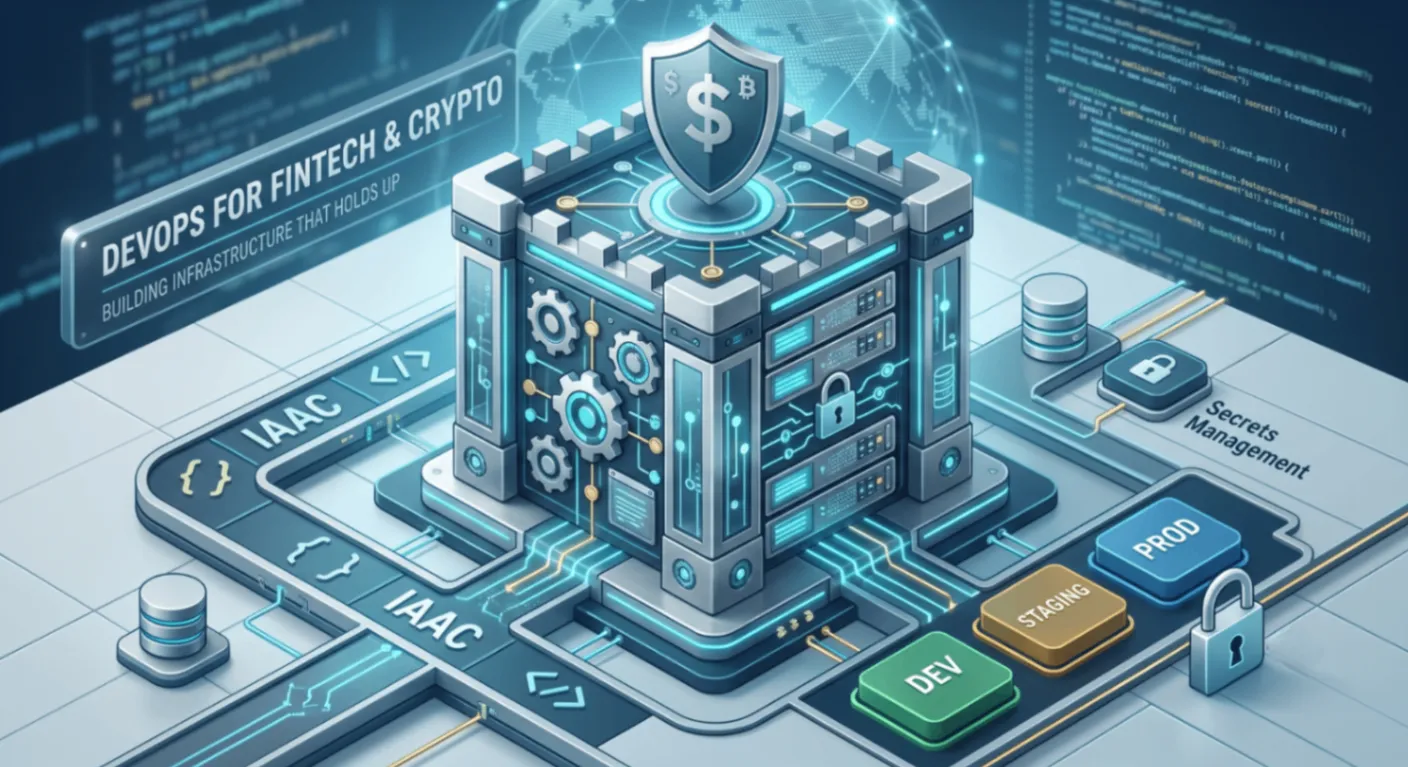
Infrastructure for a regulated or money-adjacent application carries obligations that a general-purpose web product does not. Downtime is not only a user experience problem; if your platform is part of a licensed operator’s service, an outage may be a reportable event. Logs are not only a debugging aid; they may be evidence you are required to produce and retain. And an over-permissioned deployment credential is not merely a bad practice — in a system that signs transactions, it is a direct path to loss of funds.
The practices below are the ones we apply across the applications we build and operate. None of them are exotic. They are, however, the ones most frequently deferred on the grounds that the product comes first, and then very expensive to retrofit.
Environment Isolation Means Separate Accounts, Not Separate Namespaces
The common shortcut is a single cloud account with development, staging, and production separated by naming convention or namespace. It works until a misapplied configuration change, an over-broad IAM policy, or a scripted cleanup crosses the boundary.
Genuine isolation means separate cloud accounts or subscriptions per environment, with no shared credentials and no network path between them. Production data does not flow into lower environments; where realistic test data is needed, it is generated or irreversibly anonymised. This is more work to set up and it converts an entire class of catastrophic mistake into a merely annoying one.
Infrastructure as Code, Including the Parts Nobody Codifies
Infrastructure defined in Terraform or an equivalent tool is reviewable, reproducible, and auditable. The gap in most implementations is not the compute layer — it is the accumulation of manual changes made during incidents and never brought back into code: a firewall rule opened at 2am, an IAM policy widened to unblock a deployment, a database parameter adjusted by hand.
Two habits close that gap. Drift detection runs on a schedule and reports differences between declared and actual state. And post-incident work explicitly includes codifying whatever was changed manually, treated as part of resolving the incident rather than as optional follow-up.
Secrets Management Is Where Most Teams Are Weakest
Credentials in a .env file committed early in a repository’s life, database passwords in CI configuration, API keys pasted into a chat channel to unblock a colleague — these are ordinary and they are how systems get compromised.
The working standard is a managed secrets store, such as a cloud KMS-backed secret manager or HashiCorp Vault, with secrets injected at runtime rather than baked into images or configuration files. Access is scoped per service and per environment. Rotation is scheduled rather than triggered by suspicion, and rotation is tested, because an untested rotation procedure fails at exactly the moment you need it. Repositories are scanned for committed secrets on every push, and treated as compromised when one is found, because deleting a file does not remove it from history.
Signing keys warrant stricter handling still. Any service that signs blockchain transactions should hold key material in an HSM or a cloud KMS that performs signing operations without ever exposing the key, so that a compromised application server yields the ability to request signatures under whatever policy constrains it, rather than the key itself. Those policies — amount ceilings, destination allowlists, rate limits, approval requirements above a threshold — are the actual security control, and they belong in infrastructure rather than application code.
Blockchain Infrastructure Fails in Domain-Specific Ways
Applications that read chain state inherit failure modes that generic monitoring will not catch. An RPC provider can return stale data while responding successfully, so a service that trusts a single endpoint may operate confidently on a view of the chain that is minutes or hours out of date. Chain reorganisations mean a transaction observed as confirmed can be un-confirmed, which any system that credits a user balance on first sight must handle. Nodes fall out of sync, and rate limits arrive without warning during periods of high activity.
The mitigations are redundancy across multiple independent providers with automatic failover, block-height monitoring that alerts when an endpoint lags its peers, an explicit confirmation-depth policy per chain rather than a single global constant, and reconciliation that periodically re-derives balances from chain state instead of trusting accumulated internal records.
Observability Sufficient to Answer Questions After the Fact
Structured logs, metrics, and distributed tracing are standard. What is specific to this domain is retention and integrity. If a supervisor, an auditor, or a law-enforcement request asks what happened on a given date, the answer needs to be retrievable months later, and it needs to be credible — which means logs shipped promptly to append-only storage that application credentials cannot modify or delete.
Alerting deserves as much design attention as the metrics themselves. An alert that fires frequently and is routinely dismissed is worse than no alert, because it trains the on-call engineer to ignore the channel where the real signal will eventually appear. Fewer alerts, each tied to a documented response, outperforms comprehensive coverage nobody trusts.
Backups, Recovery, and Knowing Your Actual Numbers
Most teams have backups. Fewer can state their recovery point objective and recovery time objective as measured figures rather than aspirations, and fewer still have restored from backup into a clean environment recently enough for the exercise to mean anything. A backup that has never been restored is a hypothesis.
Business continuity and disaster recovery documentation is increasingly a regulatory expectation for operators in financial services and crypto-asset markets, and the documents are only useful if they describe what the infrastructure actually does. A plan that references a failover procedure nobody has executed is a liability in an examination, not an asset.
Supply Chain and Dependencies
Dependencies are the most common route into an application that is otherwise well built. Pin versions and commit lockfiles. Maintain a software bill of materials so that when a vulnerability is disclosed you can answer whether you are affected in minutes. Run automated vulnerability scanning in CI and treat critical findings as build failures. Restrict which packages can be installed from public registries, and prefer fewer dependencies with clearer provenance over convenience libraries that pull in dozens of transitive packages.
Where to Start If You Are Behind
Few teams have all of this in place, and attempting everything simultaneously usually means finishing none of it. In order of return: get secrets out of code and into a managed store; separate production into its own account with restricted access; establish tested backups with a known recovery time; then build observability with alerting you trust. Each is independently valuable and each makes the next one easier.